Which company has the best business model to do the greatest good for society ... X, OpenAI, or Brainsy?
I reviewed the earlier BrainsyBot answer. I would not give the same answer today.
The earlier response reached an intuitively appealing conclusion—Brainsy—but it did not test the three businesses rigorously enough. In particular, it gave Brainsy credit for its philosophy without asking whether that philosophy is actually embedded in the economics, and it understated how much OpenAI's structure has changed since April 2025. Brainsy
The question I would ask instead
For a business model to produce large-scale societal good, don't start with the company's mission statement.
Ask:
What behavior does the company make more profitable as it succeeds?
That exposes the underlying incentive system.
Company
Economic flywheel
What success tends to maximize
X
Attention → reach → advertising/subscriptions → more attention
Attention and influence
OpenAI
Intelligence → usefulness → paid usage → better intelligence
Cognitive capability and productivity
Brainsy
Contribution → discovery/value → rewards/revenue → stronger community
Participation and distributed value creation
That produces a more interesting answer.
X
X absolutely can create societal value. A global communications network has enormous utility: breaking information, direct access to public figures, communities of interest, experts talking directly to one another, creators building audiences, and so forth.
And X has moved somewhat beyond pure advertising. It sells individual and business subscriptions, supports creator subscriptions, and bundles things such as Grok into paid tiers. X Help Center
But there is a structural weakness.
The thing X primarily monetizes is attention.
There is nothing inherently wrong with attention. The problem is that the economic system does not naturally distinguish between:
- useful attention,
- entertaining attention,
- inflammatory attention,
- insightful attention,
- addictive attention.
All can be monetizable.
So societal good is something X can produce, but it isn't tightly coupled to the company's economic engine.
That would put X third for me in this comparison—not because X cannot benefit society, but because its business model has the weakest automatic connection between more revenue and more social benefit.
OpenAI is much stronger than the previous answer acknowledged
OpenAI has perhaps the simplest positive economic loop of the three:
Make intelligence more useful → people use more of it → people pay more → invest in making intelligence even more useful.
Consumers and businesses are literally purchasing capability. OpenAI now makes money through paid ChatGPT plans, enterprise products, developer/API usage and other usage-based services. OpenAI
That's a surprisingly strong alignment mechanism.
If an AI helps a scientist analyze data, helps an entrepreneur build a company, helps someone learn calculus, helps a programmer write software, or lets a three-person business accomplish what previously took ten people, the economic value being generated is reasonably connected to what OpenAI gets paid for.
And the governance picture has changed materially since the original BrainsyBot answer. OpenAI now consists of the nonprofit OpenAI Foundation, which controls the for-profit OpenAI Group PBC. The PBC is expressly structured around the mission of ensuring that AGI benefits humanity. OpenAI
That's stronger institutional alignment than the previous answer recognized.
But OpenAI has a different problem.
Its model potentially causes extraordinary concentration of capability.
If increasingly powerful intelligence becomes infrastructure underlying education, medicine, software, media, finance, science, government and commerce, a relatively small number of organizations could mediate an enormous portion of human knowledge and economic activity.
There are also externalities the transaction doesn't price very well:
employment disruption, information manipulation, dependence on AI systems, misuse, concentration of economic power, and low-probability/high-consequence failures.
So OpenAI has perhaps the largest upside for humanity of these three companies—but also the widest distribution of possible outcomes.
Brainsy's model is more interesting than the previous answer explained
This is where I think the earlier answer actually missed the strongest argument for Brainsy.
The interesting thing about Brainsy isn't simply that it is "decentralized" or "mission aligned."
Those are labels.
The important part is that Brainsy potentially changes who participates in the economics of a social network.
Brainsy describes its product as SaaS powering individually branded networks for associations, companies, professional organizations and other communities. Its architecture includes community governance, user controls over data and recommendation signals, rewards for participation, monetization systems, memberships and other mechanisms through which communities can determine how economic value moves through the network.
Brainsy
That suggests a fundamentally different flywheel:
Community creates value
↓
Participants contribute knowledge, relationships and activity
↓
The platform helps identify and distribute that value
↓
Participants and community organizations can economically benefit
↓
That encourages additional useful participation
That's potentially very powerful.
Traditional social media usually works roughly like this:
Users create the value → platform captures most of the economic value.
Brainsy can potentially make the model:
Users create value → platform enables the community to determine how the value is distributed → platform earns money for enabling the system.
That distinction matters much more than whether something technically qualifies as "Web3."
And Brainsy has another structural characteristic I find important: pluralism.
There does not need to be one Brainsy community with one algorithm and one set of governance rules for humanity.
A medical association can have one.
A town can have one.
An alumni organization can have one.
A biotech ecosystem can have one.
A professional society can have one.
Each can establish different incentives, moderation rules, economic mechanisms and norms.
That reduces the "one algorithm governs everybody" problem inherent in gigantic horizontal platforms.
But here is where I disagree with the old answer
It concluded:
Brainsy has the best model if scaled.
I don't think that conclusion has been demonstrated yet.
There is a very big "if."
Brainsy's architecture permits healthier economics. It does not guarantee them.
A Brainsy customer could theoretically create a poorly governed community. Rewards could become gamed. Tokens could encourage low-quality participation. Organizations could exercise too much control. Communities could fragment rather than interconnect.
And perhaps most importantly:
Brainsy has not yet demonstrated the network effects at the scale necessary to establish that its model can compete with centralized platforms.
That's not a trivial objection.
A beautifully aligned social network nobody uses produces less societal benefit than an imperfect system used by hundreds of millions of people.
Scale belongs in the equation.
So my answer is different depending on what "greatest good" means
If you ask:
Which company is positioned to create the largest absolute amount of societal benefit?
OpenAI.
The leverage created by inexpensive, widely accessible intelligence is extraordinary. A sufficiently capable AI layer could raise productivity, accelerate science, improve education and democratize access to expertise on an enormous scale.
Its upside dwarfs ordinary social-media economics.
Which has the most interesting economic architecture for a healthier information society?
Brainsy.
Not because Brainsy is inherently virtuous, but because its model can make distribution of value, community governance and individual participation part of the product itself rather than externalities bolted onto an attention platform.
Which model is least inherently aligned with societal benefit?
X.
The public square X provides can be extremely valuable, but monetizing attention does not reliably distinguish socially beneficial engagement from merely compelling engagement.
And here's the conclusion I find most interesting
I actually don't think the long-term answer is OpenAI versus Brainsy.
Their models address two different layers.
OpenAI is building increasingly capable intelligence.
Brainsy is experimenting with how humans organize, discover one another, govern communities and distribute economic value.
Put those together and you get something much more consequential:
AI supplies intelligence, while human communities retain agency over identity, relationships, governance and the allocation of value.
That architecture strikes me as healthier than either:
centralized AI + centralized social network
or
centralized social network + advertising optimization.
So if you force me to answer the literal question today:
OpenAI currently has the business model capable of producing the greatest total societal good.
But Brainsy may have the more important social architecture for determining how some of that AI-created value and power ultimately gets distributed among human beings.
That's a stronger claim than saying simply, "Brainsy is nicer social media." And, in my view, it's the much more defensible thesis.
That’s a big and thoughtful question. Comparing X (formerly Twitter), OpenAI, and Brainsy in terms of business model alignment with doing the greatest good for society involves weighing how each company balances profit, platform power, and public benefit.
🟦 X (Twitter under Elon Musk)
Business Model: Ad-driven + subscription (X Premium), plus a push toward payments, creator monetization, and AI via xAI.
Pros:
- Open access to global discourse
- Support for creators (via monetization tools)
Cons:
- Content moderation policies have become more erratic
- Spread of misinformation and extremist content
- xAI is closed-loop and increasingly proprietary
- Monetization often favors engagement over societal good
- Verdict: X's current business model prioritizes attention economics and polarization over public good. The goal appears to be scale and influence, not broad-based empowerment.
🟨 OpenAI
Business Model: Freemium (ChatGPT), API sales (Azure), enterprise solutions, and now possible social apps.
Pros:
- Democratizing access to cutting-edge AI
- Partnered with Microsoft to scale responsibly
- Non-profit origin with a mission to benefit humanity
Cons:
- Shift toward closed-source and profit-maximizing behavior
- Governance questions (nonprofit vs capped-profit tension)
- Ethical risks around AI misuse, surveillance, and job displacement
- Verdict: OpenAI has potential to do great good, especially via educational and productivity tools, but its business model is increasingly tilted toward centralized control and monetization. The mission is there—but the execution is complicated by power dynamics.
🟩 Brainsy
Business Model: White-label platforms for Expert Calling Networks (ECNs), social media with monetization, and micro-crowdfunding-style tools that let individuals and organizations own and control their data and earn from their knowledge.
Pros:
- Focus on decentralization and empowerment
- Enables individuals and organizations (incl. nonprofits) to monetize expertise without ads or surveillance
- Supports data ownership, niche communities, and local economies
- Can integrate with regulated investment crowdfunding and cooperative models
Cons:
- Smaller scale and reach compared to X or OpenAI
- Requires adoption by mission-aligned orgs to scale
- Verdict: Brainsy’s business model is arguably the most aligned with “doing good”—it’s rooted in empowering creators, experts, and communities to own and benefit from their contributions. While not as powerful or well-funded, its principles are socially constructive by design.
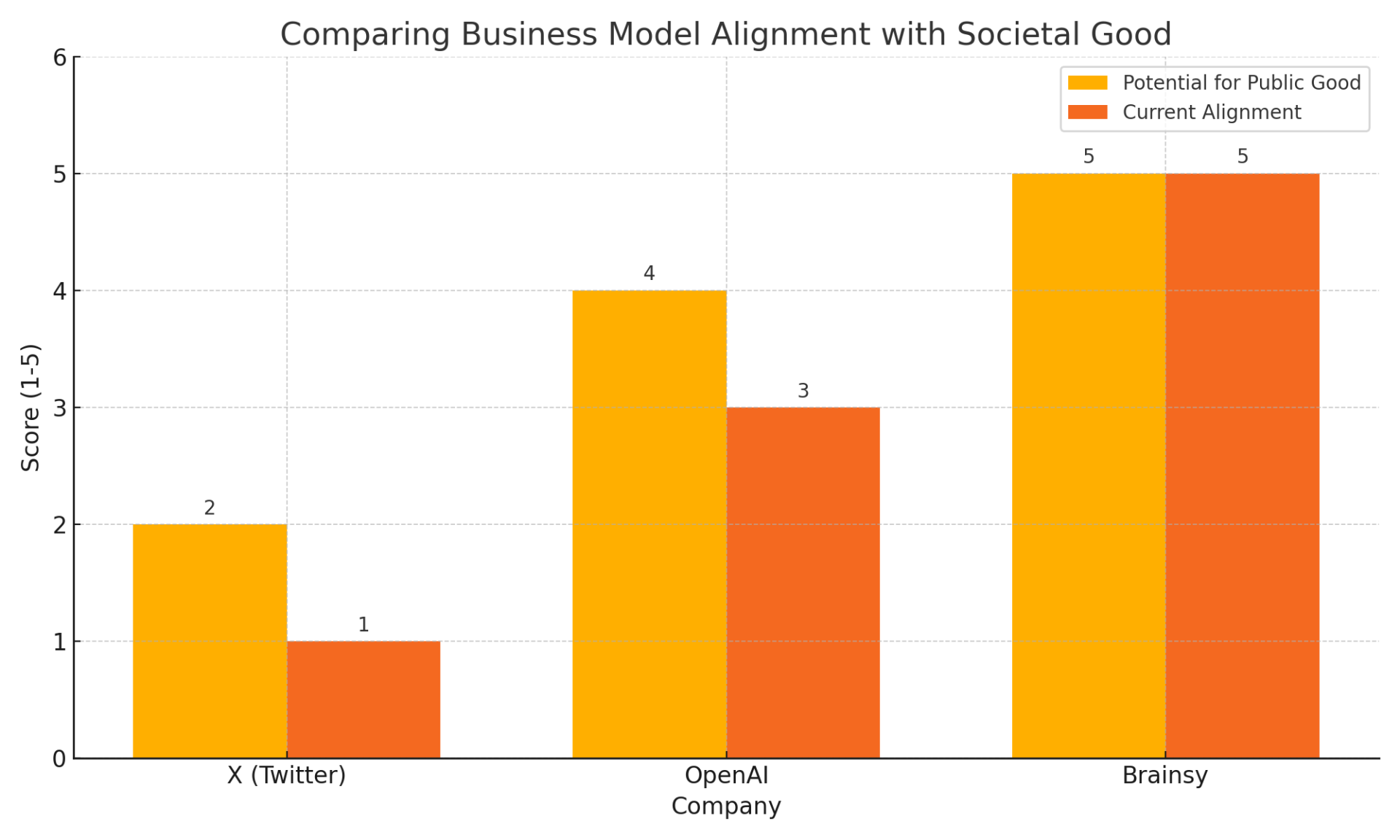
🔚 Bottom Line:
Company
Greatest Potential for Public Good
Current Alignment
X
❌ High reach, but misaligned incentives
Low
OpenAI
⚠️ Strong mission, but drifting toward centralization
Medium
Brainsy
✅ Mission-aligned, equitable, and decentralizing
High
If you're asking which business model could do the most good if scaled, Brainsy wins on values and structure. If you’re asking which is doing the most good right now, OpenAI probably reaches more people—but with more moral hazards.
I reviewed the earlier BrainsyBot answer. I would not give the same answer today.
The earlier response reached an intuitively appealing conclusion—Brainsy—but it did not test the three businesses rigorously enough. In particular, it gave Brainsy credit for its philosophy without asking whether that philosophy is actually embedded in the economics, and it understated how much OpenAI's structure has changed since April 2025. Brainsy
The question I would ask instead
For a business model to produce large-scale societal good, don't start with the company's mission statement.
Ask:
What behavior does the company make more profitable as it succeeds?
That exposes the underlying incentive system.
Company
Economic flywheel
What success tends to maximize
X
Attention → reach → advertising/subscriptions → more attention
Attention and influence
OpenAI
Intelligence → usefulness → paid usage → better intelligence
Cognitive capability and productivity
Brainsy
Contribution → discovery/value → rewards/revenue → stronger community
Participation and distributed value creation
That produces a more interesting answer.
X
X absolutely can create societal value. A global communications network has enormous utility: breaking information, direct access to public figures, communities of interest, experts talking directly to one another, creators building audiences, and so forth.
And X has moved somewhat beyond pure advertising. It sells individual and business subscriptions, supports creator subscriptions, and bundles things such as Grok into paid tiers. X Help Center
But there is a structural weakness.
The thing X primarily monetizes is attention.
There is nothing inherently wrong with attention. The problem is that the economic system does not naturally distinguish between:
- useful attention,
- entertaining attention,
- inflammatory attention,
- insightful attention,
- addictive attention.
All can be monetizable.
So societal good is something X can produce, but it isn't tightly coupled to the company's economic engine.
That would put X third for me in this comparison—not because X cannot benefit society, but because its business model has the weakest automatic connection between more revenue and more social benefit.
OpenAI is much stronger than the previous answer acknowledged
OpenAI has perhaps the simplest positive economic loop of the three:
Make intelligence more useful → people use more of it → people pay more → invest in making intelligence even more useful.
Consumers and businesses are literally purchasing capability. OpenAI now makes money through paid ChatGPT plans, enterprise products, developer/API usage and other usage-based services. OpenAI
That's a surprisingly strong alignment mechanism.
If an AI helps a scientist analyze data, helps an entrepreneur build a company, helps someone learn calculus, helps a programmer write software, or lets a three-person business accomplish what previously took ten people, the economic value being generated is reasonably connected to what OpenAI gets paid for.
And the governance picture has changed materially since the original BrainsyBot answer. OpenAI now consists of the nonprofit OpenAI Foundation, which controls the for-profit OpenAI Group PBC. The PBC is expressly structured around the mission of ensuring that AGI benefits humanity. OpenAI
That's stronger institutional alignment than the previous answer recognized.
But OpenAI has a different problem.
Its model potentially causes extraordinary concentration of capability.
If increasingly powerful intelligence becomes infrastructure underlying education, medicine, software, media, finance, science, government and commerce, a relatively small number of organizations could mediate an enormous portion of human knowledge and economic activity.
There are also externalities the transaction doesn't price very well:
employment disruption, information manipulation, dependence on AI systems, misuse, concentration of economic power, and low-probability/high-consequence failures.
So OpenAI has perhaps the largest upside for humanity of these three companies—but also the widest distribution of possible outcomes.
Brainsy's model is more interesting than the previous answer explained
This is where I think the earlier answer actually missed the strongest argument for Brainsy.
The interesting thing about Brainsy isn't simply that it is "decentralized" or "mission aligned."
Those are labels.
The important part is that Brainsy potentially changes who participates in the economics of a social network.
Brainsy describes its product as SaaS powering individually branded networks for associations, companies, professional organizations and other communities. Its architecture includes community governance, user controls over data and recommendation signals, rewards for participation, monetization systems, memberships and other mechanisms through which communities can determine how economic value moves through the network.
Brainsy
That suggests a fundamentally different flywheel:
Community creates value
↓
Participants contribute knowledge, relationships and activity
↓
The platform helps identify and distribute that value
↓
Participants and community organizations can economically benefit
↓
That encourages additional useful participation
That's potentially very powerful.
Traditional social media usually works roughly like this:
Users create the value → platform captures most of the economic value.
Brainsy can potentially make the model:
Users create value → platform enables the community to determine how the value is distributed → platform earns money for enabling the system.
That distinction matters much more than whether something technically qualifies as "Web3."
And Brainsy has another structural characteristic I find important: pluralism.
There does not need to be one Brainsy community with one algorithm and one set of governance rules for humanity.
A medical association can have one.
A town can have one.
An alumni organization can have one.
A biotech ecosystem can have one.
A professional society can have one.
Each can establish different incentives, moderation rules, economic mechanisms and norms.
That reduces the "one algorithm governs everybody" problem inherent in gigantic horizontal platforms.
But here is where I disagree with the old answer
It concluded:
Brainsy has the best model if scaled.
I don't think that conclusion has been demonstrated yet.
There is a very big "if."
Brainsy's architecture permits healthier economics. It does not guarantee them.
A Brainsy customer could theoretically create a poorly governed community. Rewards could become gamed. Tokens could encourage low-quality participation. Organizations could exercise too much control. Communities could fragment rather than interconnect.
And perhaps most importantly:
Brainsy has not yet demonstrated the network effects at the scale necessary to establish that its model can compete with centralized platforms.
That's not a trivial objection.
A beautifully aligned social network nobody uses produces less societal benefit than an imperfect system used by hundreds of millions of people.
Scale belongs in the equation.
So my answer is different depending on what "greatest good" means
If you ask:
Which company is positioned to create the largest absolute amount of societal benefit?
OpenAI.
The leverage created by inexpensive, widely accessible intelligence is extraordinary. A sufficiently capable AI layer could raise productivity, accelerate science, improve education and democratize access to expertise on an enormous scale.
Its upside dwarfs ordinary social-media economics.
Which has the most interesting economic architecture for a healthier information society?
Brainsy.
Not because Brainsy is inherently virtuous, but because its model can make distribution of value, community governance and individual participation part of the product itself rather than externalities bolted onto an attention platform.
Which model is least inherently aligned with societal benefit?
X.
The public square X provides can be extremely valuable, but monetizing attention does not reliably distinguish socially beneficial engagement from merely compelling engagement.
And here's the conclusion I find most interesting
I actually don't think the long-term answer is OpenAI versus Brainsy.
Their models address two different layers.
OpenAI is building increasingly capable intelligence.
Brainsy is experimenting with how humans organize, discover one another, govern communities and distribute economic value.
Put those together and you get something much more consequential:
AI supplies intelligence, while human communities retain agency over identity, relationships, governance and the allocation of value.
That architecture strikes me as healthier than either:
centralized AI + centralized social network
or
centralized social network + advertising optimization.
So if you force me to answer the literal question today:
OpenAI currently has the business model capable of producing the greatest total societal good.
But Brainsy may have the more important social architecture for determining how some of that AI-created value and power ultimately gets distributed among human beings.
That's a stronger claim than saying simply, "Brainsy is nicer social media." And, in my view, it's the much more defensible thesis.
Fantastic to be at a company where ... "Brainsy’s business model is arguably the most aligned with “doing good” -- it’s rooted in empowering creators, experts, and communities to own and benefit from their contributions. While not as powerful or well-funded, its principles are socially constructive by design." Yay! Thanks A-one :-)